
What Are the Types of Stepped Shafts?
In mechanical transmission systems, step shaft forgings serve as critical components for power transmission. Through the design of shaft segments with varying diameters, they perfectly fulfill multiple functions such as component positioning, torque transmission and assembly adaptation. Stepped shaft can be found everywhere, whether in automobile gearboxes, heavy rolling mills, aero-engines, motor rotors, reducers or CNC machine tools. But did you know? Stepped shafts are not a one-size-fits-all solution. Based on different classification criteria, they can be categorized into various types, each with its unique characteristics and application scenarios.
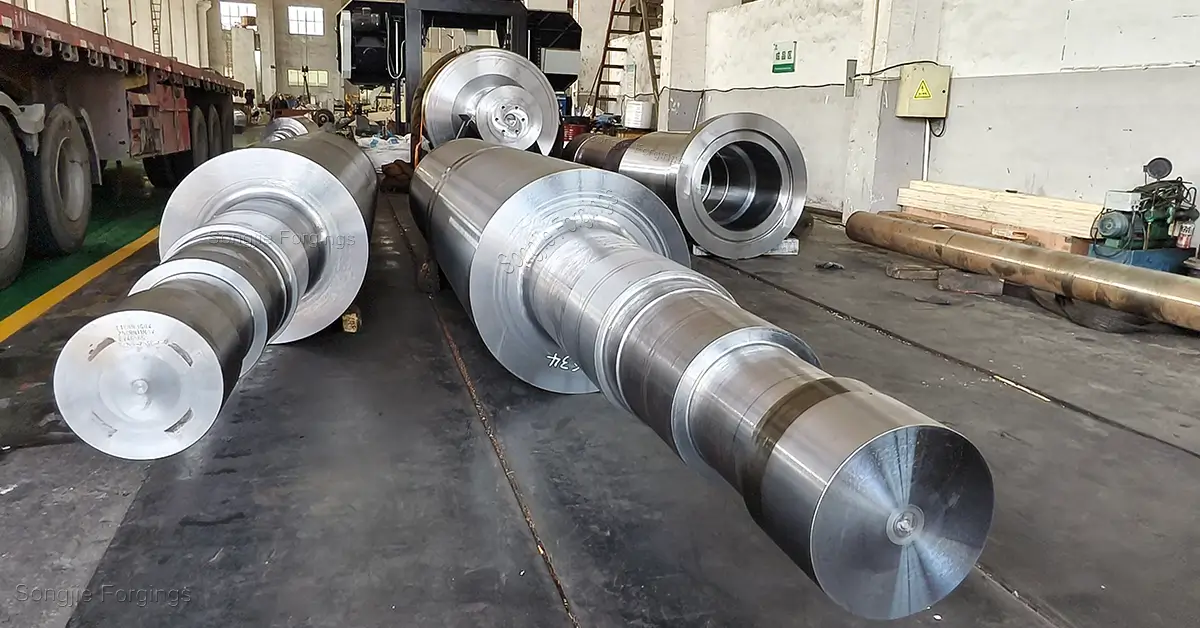


As a professional forging manufacturer, Songjie has classified stepped shafts based on the four core dimensions of “structural characteristics,” “load-bearing mode,” “functional use,” and “machining accuracy” according to the different customers’ purchased stepped shafts and their actual application needs over the years.
I. Classification by Structural Characteristics
The core of classification by structural characteristics lies in the number and arrangement of shaft segments. Different structures correspond to distinct assembly requirements and transmission logics, making this the most commonly used classification method for enterprises. It is mainly divided into the following type:
1.1 Single-step Shaft
This type of shaft consists of only one step, forming a stepped shaft with two shaft segments of different diameters – a basic structure featuring “one thick end and one thin end”. It boasts a simple structure, low machining difficulty and low production cost. It is commonly applied in simple bearing positioning, pulley installation, auxiliary shafts in household mechanical equipment, and other such scenarios.
If your equipment has simple transmission requirements and does not need multi-component positioning, a single-step shaft is fully sufficient to meet your needs and can effectively control production costs.
1.2 Multi-step Shaft
This forging features two or more shaft segments of different diameters, with the diameter varying to be larger in the middle and smaller at both ends or smaller in the middle and larger at both ends, forming multiple steps – it is the most widely used type in the industrial field. It offers diversified functions and can realize the positioning and assembly of multiple components simultaneously. It is commonly applied to automobile gearbox shafts, machine tool feed shafts, reducer input/output shafts, and so on. For the core transmission scenarios of industrial machinery for the vast majority of customers, the multi-step shaft is the preferred choice.
1.3 Variable-section Stepped Shafts
This type of shaft features shaft segments with diameters that change non-linearly (rather than in a linear increasing or decreasing manner). Its diameter variations follow an irregular pattern tailored to specific transmission requirements, and some variants are integrated with special structural features such as keyways and splines.
The variable-section stepped shaft offers an extremely high degree of customizability and can be precisely adapted to the spatial layout and force-bearing requirements of complex transmission systems. It is exclusively designed for special and complex application scenarios, and its development requires a customized design process that fully accounts for factors such as the equipment’s force analysis and spatial constraints.
1.4 Hollow Stepped Shafts
It has a stepped outer profile with a through hole at the core, which can reduce weight, facilitate wiring, lubrication or medium conveyance, and also features better heat dissipation performance. It is commonly applied in aero-engines, hydro-generator main shafts, lead screws of high-end CNC machine tools, high-speed centrifuges, and the like. However, its machining process is more complex, requiring precision machining methods such as drilling and boring, with a relatively higher production cost.
In addition to the above types, Songjie further classifies stepped shafts by structural characteristics into tapered stepped shafts, straight shafts, crankshafts, cylindrical stepped shafts, step-shaped stepped shafts, solid stepped shafts, and others.
II. Classification by Load-Bearing Mode
The core functions of forged stepped shafts are torque transmission and load bearing. Classification by load-bearing mode can directly reflect the stress state of the shaft, helping customers avoid failure risks such as fracture and deformation. It is mainly divided into the following types:
2.1 Rotating Shaft
This type of stepped rotating shaft is the most common shaft type in machinery. It bears both bending loads and transmits torque, subject to complex stress conditions, and thus needs to meet both torsion and bending resistance requirements simultaneously. The diameter design of its shaft segments must be based on stress analysis, with key reinforcement applied to stress concentration areas. It is applied in almost all rotational transmission scenarios, such as machine tool spindles, automobile gearboxes, and transmission shafts at all levels of reducers.
2.2 Mandrel
This type of shaft is subject to relatively simple stress conditions, with its design focusing on optimizing bending resistance performance. The diameter of its shaft segments can be tailored to support requirements, and there is no need for an excessively large diameter. It primarily bears bending moments only and does not transmit torque, serving to support rotating components. Furthermore, it can be further classified into fixed mandrels and rotating mandrels based on whether it rotates or not.
In addition to the above two types, stepped shafts can also be categorized by load-bearing mode into light-duty stepped shafts, medium-duty stepped shafts, heavy-duty stepped shafts, and others.
III. Classification by Functional Application
Classified by the core functions of stepped shafts such as transmission, support and positioning, they are mainly divided into the following type:
3.1 Support Stepped Shafts
The diameter variation of each shaft segment of this type of shaft forging is relatively small, with an emphasis on rigidity and coaxiality. It is mainly used to support rotating parts and perform positioning functions, and is commonly applied in machine tool spindles, printing rollers, shaft systems of measuring instruments, and the like.
3.2 Transmission Stepped Shafts
This type of stepped shaft is mainly used for transmitting torque, rotational speed and power, and is usually designed with connecting structures such as keyways, splines or flanges. It is commonly applied in power transmission systems such as gearboxes, reducers, motor output shafts and engines.
3.3 Locating Stepped Shafts
It is mainly used for axial/radial positioning and fixture fixing, with no power transmission or rotation requirements. Its core function is to provide precise mounting datums and positioning constraints for components, making it a type of stepped shaft for tooling applications. It is applied to mold clamping locating shafts, component inspection locating shafts, tooling locating shafts for assembly lines, and the like.
In addition to the above types, stepped shafts can also be classified by functional application into power transmission stepped shafts, locating datum stepped shafts, multi-functional stepped shafts, and others.
IV. Classification by Machining Precision
The machining precision of a stepped shaft directly impacts the transmission accuracy and service life of equipment. Therefore, it can be divided into the following precision grades according to precision standards, each corresponding to distinct application scenarios:
4.1 General Precision Stepped Shaft (IT8-IT10)
Stepped shafts in this precision range feature moderate machining accuracy, suitable for general transmission scenarios with low requirements for transmission precision. Typical applications include agricultural machinery, small general-purpose equipment and simple transmission devices.
4.2 Precision Stepped Shaft (IT5-IT7)
This type of stepped shaft boasts high machining accuracy and requires precision machining processes such as precision turning and grinding. It is typically applied in the core transmission scenarios of mid-to-high-end machinery.
4.3 Ultra-Precision Stepped Shaft (IT1-IT4)
Stepped shafts in this grade offer extremely high machining accuracy and require ultra-precision manufacturing processes such as ultra-precision grinding and polishing, resulting in relatively high production costs. They are suitable for aero-engine main shafts, transmission shafts of precision instruments, core shafts of semiconductor equipment, and the like.
Conclusion
Beyond the four dimensions of classification mentioned above, stepped shafts can also be categorized by manufacturing process, material properties, connection method, and so on, specifically including integral stepped shafts, welded stepped shafts, alloy stepped shafts, forged stepped shafts, and so on. Regardless of the classification, Songjie supports customization of various types, providing high-quality stepped shaft. Moreover, the shape and structural design of our stepped shaft forgings are tailored to meet specific customer requirements, and we are committed to providing strong support for the development of the industry.