
What Is a Gear? – A Complete Guide to Gears
Have you ever wondered what enables the transmission of power in various mechanical equipment, allows vehicles to accelerate smoothly, keeps wind turbines generating electricity continuously, and empowers robots to turn flexibly? The answer lies in gear, the core components across all mechanical fields. A gear is a toothed mechanical transmission element that transfers power and motion through the continuous meshing of gear teeth. As one of the most widely adopted transmission solutions in modern industry, it transmits rotational motion from one shaft to another while adjusting rotational speed, torque and rotation direction. If you are interested in gears or searching for a high-quality gear supplier, this comprehensive guide will give you in-depth insights into all aspects of gears manufactured by Songjie, supporting you to make optimal procurement decisions.


Ⅰ. Core Terminology
Before an in-depth understanding of gears, it is essential to master basic gear terminology, which helps you better comprehend their working principles and application scenarios:
1.1 Module: A critical parameter in gear design that indicates gear size. It refers to the ratio of the addendum circle diameter to the number of teeth, generally measured in millimeters (mm).
1.2 Number of Teeth: The total quantity of teeth on a gear, which directly determines the gear transmission ratio.
1.3 Pressure Angle: The contact angle between tooth surfaces during gear meshing. Common standard pressure angles are 20° and 14.5°. It defines the tooth profile and affects meshing efficiency as well as structural strength.
1.4 Addendum Circle: The outer circle of gear addendums, representing the maximum outer diameter of a gear.
1.5 Dedendum Circle: The inner circle formed at the root of gear teeth.
1.6 Reference Circle: The reference circle for calculating gear geometric dimensions, serving as the most essential imaginary circle in gear design.
1.7 Tooth Space: The recessed space between two adjacent gear teeth.
1.8 Gear Center Distance: The center spacing between two meshing gears, a vital parameter for mechanical design.
1.9 Gear Tooth: Each protruding meshing structure on a gear.
1.10 Gear End Face: The plane perpendicular to the axis of cylindrical gears or cylindrical worms.
II. Advantages and Features
✅ Ultra-high transmission efficiency and smooth transmission performance
✅ Excellent load capacity and high precision
✅ Flexible speed regulation and torque conversion
✅ Enable steering transmission at various angles
✅ Long service life with predictable durability
✅ Wide transmission ratio and power range
✅ Compact, lightweight, easy to install and maintain
✅ Strong environmental adaptability
III. Structural Classification
3.1 Classification by Gear Structure
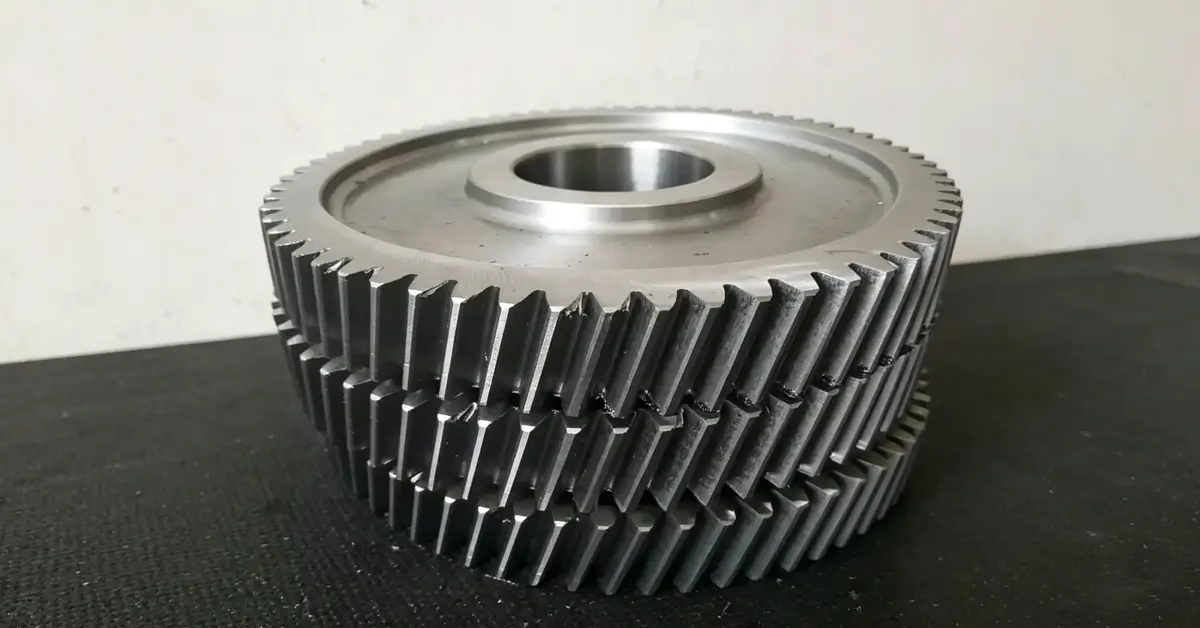
Spur Gear, Helical Gear, Bevel Gear, Worm Drive, Internal Gear, Cylindrical Gear, Planetary Gear, Non-Circular Gear, Gear Rack, Herringbone Gear, etc.
3.2 Classification by Shaft Position
Parallel Shaft Gear, Intersecting Shaft Gear, Crossed Shaft Gear, Involute Gear, and other types.
3.3 Classification by Manufacturing Process
Cast Gear, Cut Gear, Rolled Gear, Sintered Gear, etc.
3.4 Classification by Application
Transmission Gear, Speed Change Gear, Precision Gear, Heavy-Duty Gear, etc.
IV. Gear Materials
Songjie supplies gear materials to meet diverse application requirements and provides customized solutions.Our commonly available gear materials cover alloy steel, tool steel, mold steel, stainless steel, carbon steel and aluminum alloy.We also offer a full range of heat-treated steels, including quenched and tempered steel, quenched steel, carburized and hardened steel, as well as nitrided steel.
V. Processing Methods
Gears are generally manufactured through the following processes:
5.1 Precision Forging or Blanking
Form qualified gear blanks to enhance gear strength and toughness while eliminating internal defects.
5.2 Cutting Processing
Machine basic structures such as outer circles, end faces and bore holes. Ideal for mass production and guarantees high tooth profile accuracy.
5.3 Gear Hobbing
The most widely adopted tooth forming process. It utilizes continuous meshing cutting between hobs and gear blanks, featuring high efficiency and low cost. It is the preferred option for mass production and most aluminum alloy and steel gear orders.
5.4 Gear Shaping
Delivers higher precision than hobbing. It is mainly applied to workpieces difficult to process by hobbing, such as internal gears and compound gears, perfectly meeting customized production requirements.
5.5 Gear Grinding
Provides ultra-high dimensional accuracy with smooth, wear-resistant tooth surfaces and low operation noise. It is applied to high-precision and high-strength gears for aerospace equipment and precision machine tools.
5.6 Gear Shaving
An optimal process for improving surface finish. It effectively reduces operating noise and upgrades tooth surface accuracy and overall surface quality.
5.7 Heat Treatment
Including carburizing and quenching, quenching and tempering, nitriding, surface hardening and other processes, to comprehensively improve mechanical performance and extend the service life of gears.
VI. Application Fields
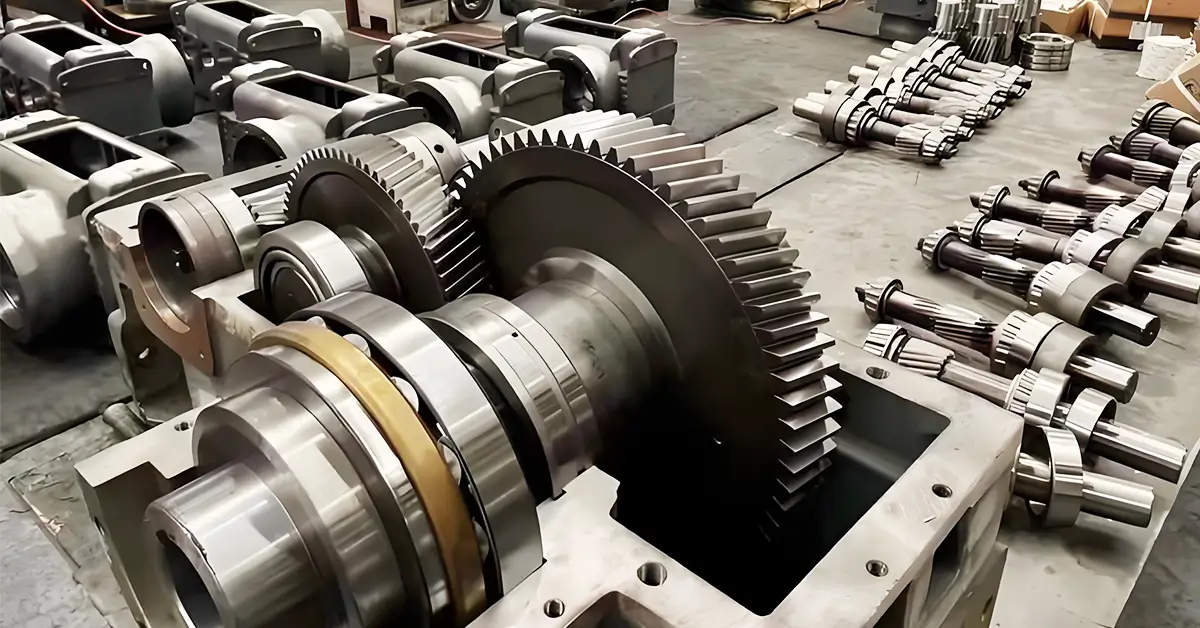
Gears are widely applied across nearly all industrial sectors, mainly including automotive, aerospace, energy equipment, robotics and automation, construction machinery, medical devices, machine tools and more. In these industries, gears are commonly used in transmissions, differentials, steering systems, aero-engines and control systems, speed-increasing gearboxes for wind turbines, high-precision motion control units, and other core components.
VII. Supply Scope
At Songjie, we deliver a full range of gear solutions to fully meet customer requirements.
- Material Range: 20CrMnTi carburized steel, 45# steel, 40Cr, 42CrMo, 38CrMoAlA nitriding steel, copper, aluminum alloy, stainless steel, alloy steel, and more.
- Diameter Range: φ10mm to φ3000mm
- Processing Accuracy: DIN Class 4–10
- Module Range: M0.5 ~ M50+
- Customization: Custom processing per drawings or samples is available, covering spur gears, helical gears, bevel gears, internal gears, gear racks, planetary gears and other types to satisfy personalized demands.
- Surface Treatment: Phosphating, zinc plating, PVD coating and other treatments are supported.
- Quality Assurance: Equipped with comprehensive testing capabilities, including gear measuring center, material spectrum analysis, metallographic structure inspection and hardness gradient testing. Third-party inspection is also acceptable.
VIII. Gear Frequently Asked Questions (FAQ)
A: Aluminum alloy gears can reduce overall weight, yet they require reduced load capacity or an increased module/tooth width. Pure aluminum alloys are not suitable for heavy-load conditions. However, aluminum matrix composite materials or combined steel-aluminum structures can achieve weight reduction while meeting structural strength requirements.
A: Gear replacement is required in the following cases: pitting area on the tooth surface exceeds 15%, tooth root cracks appear, excessive backlash causes abnormal noise, or tooth surface scuffing and severe wear occur. Predictive maintenance systems with vibration analysis are recommended for early failure warning.
A: ① Check for excessive gear backlash;② Verify whether the tooth surface roughness meets standards;③ Confirm the gear accuracy class matches the operating speed;④ Ensure sufficient lubrication.
A: Module (m) is a metric parameter measured in millimeters, used to define tooth size for metric gears. Diametral Pitch (DP) is an imperial parameter based on inches for imperial gears. The two parameters have a reciprocal conversion relationship.
A: Heat treatment greatly improves tooth surface hardness and core toughness, enabling gears to balance wear resistance and impact resistance. It directly determines the overall service life and comprehensive mechanical performance of gears.
Conclusion
In summary, gear serve as the core components of mechanical transmission and play an indispensable role across industrial applications. At Songjie, we specialize in the manufacturing of precision gear and support a full range of processing technologies. Properly processed high-quality gears can significantly improve the overall service life and operating efficiency of complete equipment. We guarantee reliable quality, precision manufacturing and stringent quality inspection at every production stage. Choosing Songjie will be your optimal solution for premium gear procurement.